Alter Eco Pulp · Materials and design
Molded fiber, paperboard and plastic: which should you choose for your packaging?
Choosing a packaging material means making a decision that affects your product, your brand and your customers. Packaging needs to protect its contents, present them in the right way and perform during transport, packing and use.
Molded fiber, paperboard and plastic offer different possibilities. To find the right direction, start with a practical question:
What do you want to achieve with your packaging?
The answer will help you identify which characteristics really matter and where it makes sense to invest.
Start with what you want to improve
A bottle that moves around inside its box, an insert that needs rethinking or packaging that does not reflect the brand’s positioning: every project starts with a need.
Identifying the main one helps guide the decisions that follow. Do you want to improve presentation? Reduce plastic? Make packing easier? Or rethink packaging made up of too many components?
The clearer your goal, the more useful the comparison between materials will be.
Molded fiber, paperboard and plastic: what can they offer?
Paperboard and molded fiber share a common foundation: cellulose fibers. The difference lies in how they are processed and, as a result, the shapes and solutions they make possible.
Molded fiber: freedom of form
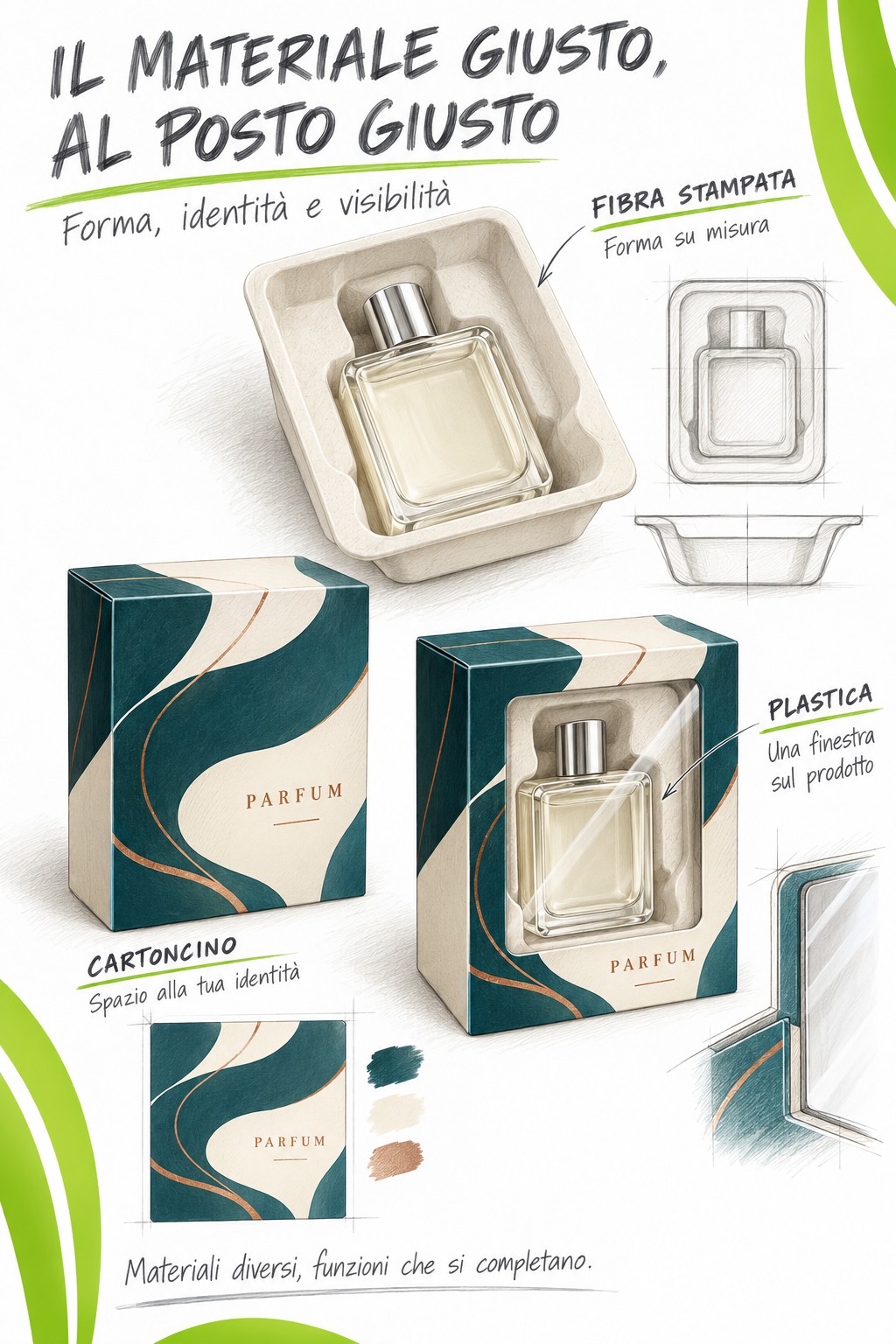
Molded fiber can be used to create three-dimensional components such as inserts, trays and shaped supports, as well as complete packaging.
It is an option to consider when you want to create a housing around a product, define its points of support or organize several items within the same pack. The shape of the insert becomes part of both protection and presentation.
Think of a gift set containing a bottle and an accessory: a custom insert can give each item its own space and create an orderly presentation when the box is opened.
To achieve a good result, the geometry needs to be designed together with the material. When replacing an existing component, some details may need to change to make the most of what molded fiber can offer.
Paperboard: graphics and structural design
Paperboard starts as a sheet that is printed, cut, folded and assembled. This makes it an interesting starting point for folding cartons and packaging where graphics play a central role.
Colors, images and information can cover large surfaces, helping make the product recognizable and tell the brand’s story.
Inserts can also be made from paperboard. In this case, it is useful to assess the quantity required, how the inserts support the contents and how many steps are needed to assemble them and place them inside the packaging.
For very small quantities, a paperboard solution may be more economical. At higher volumes, a molded fiber insert may become an attractive option: cost and sustainability should be assessed across the complete packaging solution.
Paperboard and molded fiber can also work together: a printed outer carton and a shaped insert can meet complementary needs.
Plastic: assess where its properties are needed
Plastic covers a range of materials, with properties that need to be assessed in relation to their intended use.
If part of the packaging needs to be transparent or flexible, a plastic solution may be appropriate. The useful question is where that property is actually needed and what function it serves.
For example, if you want the product to be visible from the outside, it is important to clarify how much needs to be seen and through which part of the packaging. This helps determine the size of the transparent area required and the possible combinations with other materials.
Defining these requirements also helps identify where plastic could be reduced or replaced while maintaining the functions needed.
The cost and value of the complete packaging
Assessing packaging means considering the value it can create as a whole. Product protection, perceived quality, sustainability, ease of use and consistency with the brand all contribute to the strength of the final solution.
The value lies not only in the material used, but also in the opportunity to build a solution around the product, aligning the packaging with the brand’s objectives.
When shape, function and sustainability work together, packaging becomes more than a container: it becomes part of the product’s value.
Define what sustainability is worth to you and your customers
How much does sustainability influence your brand’s decisions? And how much does it matter to the people buying your products? Answering these questions helps you understand the value to place on packaging, even when a solution requires a greater investment.
If sustainability is part of your positioning, packaging offers a practical opportunity to make it visible. The materials chosen, the quantities used and how easily components can be separated can all help communicate that choice and make it understandable to the customer.
Value comes from a tangible improvement that the brand can explain and the customer can recognize.
Tell us what you want to achieve with your packaging.
Share an image, a drawing or the packaging you currently use: it will be a starting point to explore together how molded fiber could contribute to your project.
Let’s discuss your packagingOr email us at info@alterecopulp.it